

The Tennessee Log Cabin Wish List
By mid-November, East Tennessee has changed.
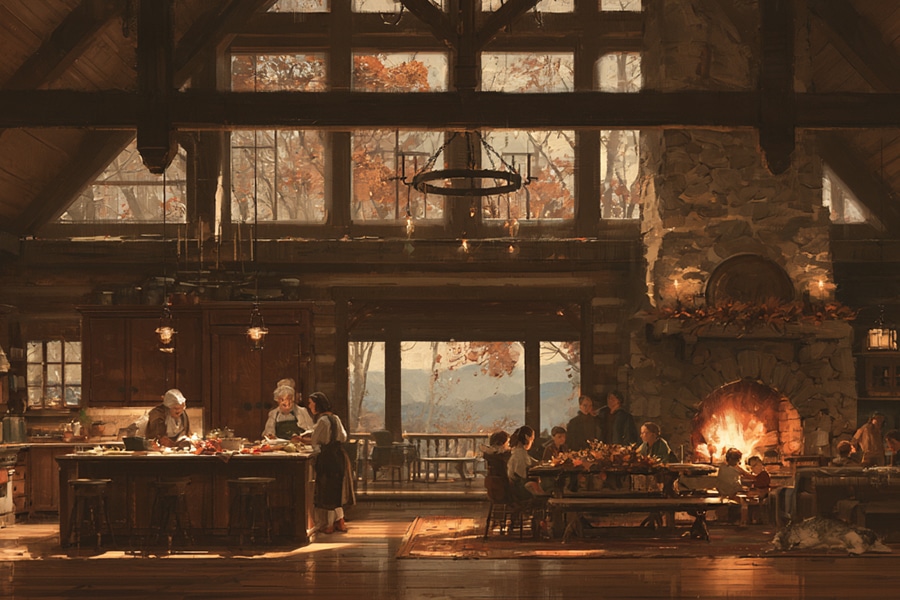
The spectacular October color show has mostly moved from the trees to the ground. Mountain views that were partially hidden behind summer foliage can suddenly stretch much farther. The mornings have a bite to them. Sunset arrives earlier. Fireplaces that spent the summer looking decorative are beginning to earn their keep.
It’s also the time of year when a house starts revealing whether it was designed for real life.
That beautiful porch you loved in May? You may now be wishing part of it were screened or protected from the wind. The gorgeous great room suddenly feels even better with a fire going. The mudroom you weren’t sure you needed is looking increasingly brilliant every time someone walks through the door wearing wet boots.
And if Thanksgiving is happening at your house, you’re about to learn exactly how well the kitchen, pantry, guest rooms and bathrooms work when the population temporarily triples.
That’s one reason planning a log home shouldn’t begin with a catalog of features.
It should begin with experiences.
Imagine a rainy Tuesday. A freezing January morning. A July afternoon. Thanksgiving dinner with 14 people. Grandchildren staying for the weekend. Coming home with muddy boots. Losing power for a few hours. Bringing home something enormous from the hardware store and discovering that your storage room door is approximately three inches too narrow.
Those are the moments that create the real wish list.
Most people remember the obvious things when designing a Tennessee log home. They remember the fireplace. They remember the porch. They remember the big windows and exposed beams.
It’s often the less glamorous decisions that homeowners appreciate most after they’ve lived there for a few years.
Here are 15 we’d put near the top of the list.
1. A Porch That’s Deeper Than You Think You Need
Nobody building a log home in East Tennessee needs to be convinced that porches are a good idea.
The question is whether the porch is large enough to become an actual living space.
There’s an enormous difference between a porch that accommodates two rocking chairs and one that can hold comfortable seating, a dining table, a grill and enough circulation space that nobody has to turn sideways to get around everything.
Think about furniture while you’re designing it.
A six-foot-deep porch can look perfectly reasonable on a drawing. Then you put a substantial chair on it and discover that the porch is considerably less substantial than you imagined.
A deeper covered porch also gives you more options as the seasons change. In summer, shade becomes valuable. During rainy weather, additional depth can help protect the area. By November, you may want a section where you can sit outside with coffee without feeling quite so exposed to the weather.
If outdoor living is one of the reasons you’re moving to East Tennessee, don’t treat the porch as decoration.
Build it like a room.
2. A Screened Section of That Porch
This is the feature people sometimes dismiss because they don’t want anything between themselves and the view.
Then summer arrives.
So do mosquitoes.
And moths.
And every other small flying creature in Tennessee that apparently received an invitation to dinner.
You don’t necessarily need to screen the entire porch. In fact, having both open and screened areas can give you the best of both worlds.
The open section preserves that completely unobstructed connection to the landscape. The screened section becomes the place for meals, evening conversations and summer nights when the insects are feeling particularly sociable.
Come November, a screened porch can still be useful on milder days, particularly if it has some protection from wind.
A good porch doesn’t just extend the house.
It extends the calendar.
3. More Mudroom Than You Planned
Mudrooms are easy to shrink during the design process because nobody walks into a model home and gasps:
“Look at this magnificent mudroom!”
But give it a few years.
In rural and mountain living, an everyday entrance has to handle an impressive collection of stuff.
Boots. Coats. Dog leashes. Backpacks. Garden gloves. Packages. Hats. Umbrellas. Hiking equipment. Grocery bags waiting for their second trip to the car.
And in November, all those things seem to get wetter and bulkier.
A bench is useful. Hooks are useful. A closet is even better. A durable floor that doesn’t panic when someone walks across it wearing muddy boots is wonderful.
If you have dogs, consider where towels, food, leashes and other pet supplies will live.
Your mudroom doesn’t need to be enormous.
It just needs to be large enough that the mud actually stays in the mudroom.
4. A Pantry You Can Walk Into
Kitchen cabinets are excellent.
They’re also remarkably talented at hiding the ingredient you’re absolutely certain you purchased last week.
A dedicated pantry changes how a kitchen works, particularly if you live farther from major shopping areas and tend to keep more staples at home.
It doesn’t have to be enormous.
A modest walk-in pantry with well-designed shelving can hold food, small appliances, serving pieces, paper goods and bulk items that would otherwise consume valuable kitchen cabinets.
For people who entertain frequently, it can also keep the visible kitchen from becoming storage headquarters.
And then Thanksgiving arrives.
Suddenly the pantry isn’t merely convenient.
It’s mission control.
5. More Kitchen Counter Than You Think You’ll Use
This is related to the pantry, but it’s worth considering separately.
A kitchen designed for two people behaves very differently when eight people are standing in it.
And for reasons science has yet to explain, guests always stand in the exact location where the cook needs to be.
Generous counter space gives you flexibility.
It provides room for food preparation, serving and the parade of slow cookers that seems to accompany every large family gathering.
An island can help, but don’t make it so enormous that navigating around it becomes a hiking trail.
The best kitchen isn’t necessarily the largest.
It’s the one where several people can do different things without repeatedly saying:
“Sorry. Can I get by you?”
6. A Main-Floor Bedroom and Full Bathroom
Even if you’re not building a retirement home, this deserves serious consideration.
A main-floor bedroom creates options.
It can serve as the primary suite from the beginning. It can be a guest room for parents or visitors who don’t handle stairs comfortably. It can become an office temporarily and return to bedroom duty later.
If your home has a loft or second floor, putting at least one bedroom and full bathroom downstairs means the entire house doesn’t depend on stairs.
That’s useful at 70.
It’s also useful at 40 when you’ve sprained an ankle.
Forever-home features have an interesting habit of being everybody-home features.
7. Laundry Where the Laundry Actually Happens
Laundry rooms are sometimes positioned wherever there happened to be space left on the floor plan.
That’s backwards.
Think about where clothes, towels and linens originate.
If the primary bedroom is on the main floor, having laundry nearby can eliminate countless trips across the house.
A laundry room near the mudroom can also be helpful for dirty outdoor clothing.
If you have a two-story house with most bedrooms upstairs, the calculation may be different.
The point isn’t that there’s one perfect location.
It’s that you’ll walk between bedrooms and the laundry room thousands of times over the life of the house.
Saving 30 unnecessary steps doesn’t sound exciting.
Multiply it by 20 years.
It gets more exciting.
8. An Actual Place for Firewood
A stone fireplace or wood stove looks fantastic in a log home.
The logs feeding it are considerably less photogenic when they’re piled randomly near the back door.
If wood burning will be part of your home, plan where firewood will be stored.
You want it reasonably convenient without creating moisture or pest problems against the house. A covered outdoor storage area or woodshed can keep the supply dry and organized.
Then consider how wood travels from storage to the fireplace.
If the route requires crossing a formal living area carrying wet logs, bark and approximately 700 tiny pieces of forest, you may eventually reconsider the route.
In November, when you’re actually using the fireplace regularly, good firewood planning suddenly feels like architectural genius.
9. A Utility Sink
This may be the least glamorous item on our list.
It might also be one of the most useful.
Put a deep utility sink in the mudroom, laundry room, garage or workshop and watch how often it gets used.
Muddy gardening tools.
Paintbrushes.
Dog-related emergencies.
Dirty boots.
Things you absolutely do not want anywhere near the kitchen sink.
A utility sink is the kind of feature nobody photographs for the real-estate listing.
The person who actually lives in the house knows better.
10. A Workshop or Hobby Space
We mentioned this in our forever-home discussion, and we’re putting it on the wish list again because it deserves to stay there.
If you have a hobby, give it a home.
Woodworking, crafts, gardening, music, restoring cars, painting, fishing equipment—whatever you enjoy doing shouldn’t necessarily spend the next 20 years being shuffled around because it never received dedicated space.
A workshop can be attached or detached.
A hobby room can be modest.
The important part is acknowledging that a house isn’t merely somewhere you eat and sleep.
Especially in retirement, it’s where you finally have time to do the things you’ve spent decades saying you’ll do when you have time.
Congratulations.
This is the time.
11. An Outdoor Faucet Where You Actually Need One
This one sounds ridiculously small.
Until you’ve dragged 150 feet of garden hose around the house.
Think about where you’ll wash vehicles, water plants, clean outdoor furniture, fill a kiddie pool for visiting grandchildren or rinse muddy equipment.
If you’re building on acreage, consider outdoor needs beyond the immediate house as well.
Strategically placed water access can make everyday property maintenance easier.
It’s inexpensive to think about during planning.
It’s considerably more annoying to discover later that the only outdoor faucet is on the opposite side of the house from everything involving water.
12. More Electrical Outlets Than 1995 Thought You Needed
Modern homes have an astonishing number of things that need electricity.
Phones.
Tablets.
Laptops.
Televisions.
Kitchen appliances.
Tools.
Outdoor lighting.
Holiday decorations.
Battery chargers.
Internet equipment.
And a growing collection of devices whose sole purpose seems to be telling you something another device could have told you.
Plan outlets around furniture and activities rather than simply spacing them around walls.
Think about the porch.
The kitchen island.
The workshop.
The garage.
Outdoor areas.
Potential television locations.
Holiday decorating.
A floor outlet can sometimes solve a furniture-layout problem in a large great room.
And if you’re planning a home office, treat power and connectivity as infrastructure rather than an afterthought.
Extension cords are useful.
They should not become an architectural style.
13. A Real Mechanical and Utility Area
Mechanical equipment has to live somewhere.
Give it somewhere sensible.
HVAC components, water treatment equipment, electrical panels, networking equipment and other systems should be accessible for inspection and service.
Trying to save a few square feet by squeezing important equipment into impossibly tight spaces may seem clever on a floor plan.
The technician who eventually has to work on it may have a different opinion.
The same goes for shutoff valves and other controls.
Know where they are.
Make them reachable.
Someday something will need attention.
Homes are remarkably committed to this tradition.
14. Storage for the Things You Don’t Own Yet
This sounds like we’re advocating hoarding.
We’re not.
We’re advocating reality.
Your possessions will change over time.
Grandchildren may arrive.
Hobbies expand.
Seasonal decorations reproduce when left unattended.
You may buy kayaks, bicycles, gardening equipment or tools you don’t currently own.
A little flexible storage gives your house room to absorb those changes.
Attics, closets, garage shelving, built-ins and dedicated storage rooms can all help.
Just don’t create storage that’s technically enormous but practically inaccessible.
If retrieving the Christmas decorations requires mountaineering equipment, the storage design needs another look.
15. The Thing You’ve Always Wanted
This one is different.
Forget resale.
Forget trends.
Forget what somebody on television says every house is supposed to have.
What have you always wanted?
A reading nook?
A massive stone fireplace?
A library?
A covered outdoor fireplace?
A window seat overlooking the mountains?
A woodworking shop?
A soaking tub?
A garden room?
A ridiculously comfortable porch with four rocking chairs even though only two people live there?
Put something in the house simply because it will make you happy.
A custom log home shouldn’t be a collection of practical compromises.
Practicality makes the house work.
Personality makes it yours.
November Is a Pretty Good Test of a House
It’s easy to imagine a Tennessee log home on a perfect May afternoon.
November asks tougher questions.
Where do the wet coats go?
Is the fireplace convenient to use?
Does the house still get good natural light as the days shorten?
Is there somewhere comfortable for everyone when outdoor living slows down?
What happens when family arrives for Thanksgiving?
Can three people cook without declaring territorial boundaries around the kitchen island?
Where will everybody sit?
And when dinner is finished, is there somewhere for different generations to spread out?
Those aren’t glamorous architectural questions.
They’re living questions.
And those are usually the questions that determine whether a house feels wonderful five years after the excitement of building it has faded.
Put Your Money Into the Things You’ll Touch Every Day
When budgets tighten during construction, it’s tempting to protect the dramatic features and cut the ordinary ones.
Sometimes that makes sense.
Sometimes it doesn’t.
A slightly smaller great room with a good pantry, useful mudroom and sensible storage may make you happier than a gigantic great room surrounded by nowhere to put anything.
A thoughtfully designed porch may bring more enjoyment than another seldom-used bedroom.
Good flooring matters because you walk on it every day. Quality doors matter because you open them every day. The character of your logs, log siding, beams, tongue-and-groove and trim matters because those materials become the backdrop to everyday life.
That’s one of the reasons planning and materials have to work together.
At East Tennessee Building Supply, the logs, siding, flooring, beams, tongue-and-groove, railings, trim and other components may be the visible pieces of the home.
But the best results happen when those materials support a house designed around the people who will actually live there.
By the time Thanksgiving rolls around, nobody is going to compliment you on how efficiently you used the square-footage calculation on your original floor plan.
They’ll remember the fire.
They’ll remember everyone gathered in the kitchen.
They’ll remember the porch.
They’ll remember the view through the bare November trees.
And years later, you’ll probably remember a few little decisions nobody noticed at all.
The outlet exactly where you needed it.
The mudroom that contained the muddy dog.
The pantry that somehow held Thanksgiving.
The downstairs bedroom that became more useful than you ever expected.
And hopefully, somewhere in that house, there’s also the one completely unnecessary thing you built simply because you’d always wanted one.
Because if you’re finally building your Tennessee log cabin, that deserves a spot on the wish list too.
