
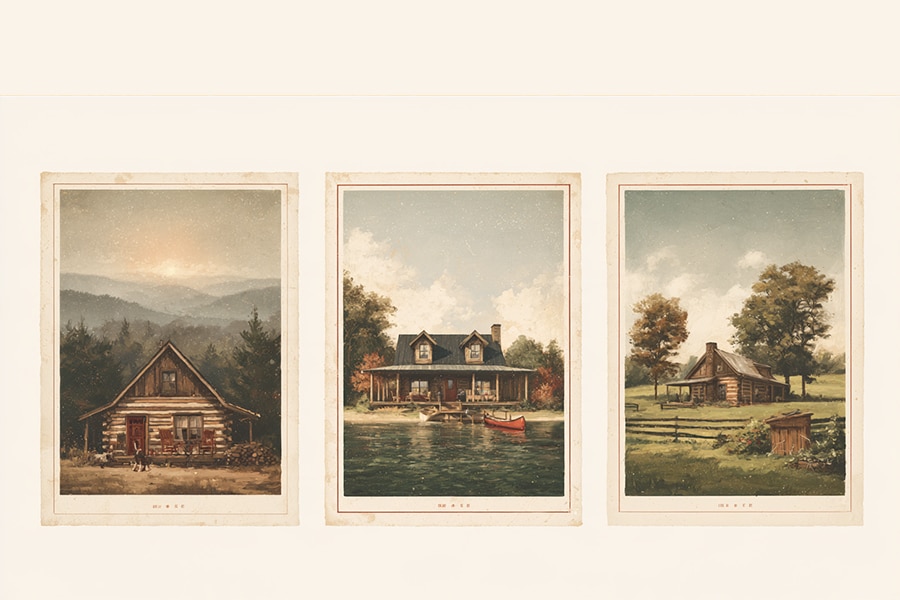

Choosing Your East Tennessee Lifestyle
There are plenty of decisions to make when you’re dreaming about a log home in East Tennessee. How big should it be? Full logs or log siding? One story or two? Rustic or contemporary? How much porch is enough porch?
But there’s an even bigger decision that should probably come first:
Where—and how—do you actually want to live?
Because “a log home in East Tennessee” can describe three surprisingly different lives.
For some people, the dream is waking up to layers of blue-green mountains outside the bedroom window, drinking coffee above the morning fog and having the Great Smoky Mountains practically in the backyard. For others, retirement doesn’t look complete without water—a lake nearby, a boat at the ready and summer afternoons that somehow turn into evenings without anyone noticing.
And then there’s another version of East Tennessee that doesn’t always make the vacation brochures: a few acres of rolling countryside, a log home set well back from the road, maybe a garden, workshop or barn, and enough elbow room that the nearest traffic jam involves a tractor.
All three can be wonderful.
All three can also involve very different decisions about land, home design, maintenance, accessibility, outdoor living and what you’ll actually do every day.
That’s why choosing between a Tennessee mountain cabin, lake-area log home and country property shouldn’t begin with which one produces the prettiest photograph.
It should begin with a better question:
What do you want your ordinary Tuesday to look like?
The Mountain Cabin: When the View Is Part of the House
There’s a reason the mountain cabin remains the image many people immediately associate with East Tennessee.
The Great Smoky Mountains and surrounding foothills can provide a spectacular backdrop for a log home. Depending on where you build, you might have long-range mountain views, dense woodland, dramatic changes in elevation or a combination of all three.
And those surroundings can influence the house itself.
A mountain log home may be designed to point its largest windows toward the view. A deck or covered porch can become almost as important as the living room. Sloping land may make a walkout lower level practical. Tall windows, vaulted ceilings and open living spaces can help bring the landscape visually into the house.
The result can be spectacular.
But there’s another side to mountain living that deserves just as much attention.
Mountain-property questions worth asking:
- How steep is the building site?
- How difficult will the driveway be?
- Can construction and delivery trucks comfortably reach it?
- What will the road be like after heavy rain or during occasional winter weather?
- How much grading or site preparation could be required?
- Where will water naturally travel across the property?
- How close are groceries, healthcare and everyday services?
- Will the view change when summer foliage fills in?
That last one is easy to overlook.
A property viewed in January can have a tremendous long-range view through bare hardwood trees. By June, Mother Nature may have installed curtains.
That’s not necessarily bad. Just know what you’re buying.
Who Is the Mountain Log Home Best For?
Mountain living can be a terrific fit if the setting itself is one of your biggest priorities.
You may be the person who wants to hike regularly, photograph sunsets, watch storms move through distant valleys or simply sit outside and stare at the mountains.
Privacy can be another attraction.
Depending on the property, a mountain home can feel remarkably removed from the rest of the world without actually being terribly far from civilization.
For retirees, though, we’d put accessibility fairly high on the checklist.
The perfect retirement mountain home isn’t automatically the cabin perched on the most dramatic piece of land available. Sometimes a gentler property with an easier driveway and slightly less dramatic elevation provides 95 percent of the experience with considerably fewer everyday complications.
There are no medals awarded for having the steepest driveway in Tennessee.
The Lake Cabin: When Life Naturally Moves Outdoors
Then there’s lake life.
East Tennessee is home to numerous reservoirs and waterways, and a log home near the water creates a very different lifestyle from one tucked high into the mountains.
The focus shifts outward.
Morning coffee might happen on the deck. Boats, kayaks, fishing equipment and wet towels become part of everyday logistics. Summer visitors suddenly become much easier to attract.
Funny how that works.
A lake-oriented log home may put particular emphasis on outdoor gathering areas, rear porches, large windows and convenient transitions between the house and water-facing portions of the property.
A mudroom becomes even more valuable.
So does storage.
Lots of storage.
Think beyond the dock
Before falling for a waterfront or lake-area property, think about:
- Actual water access
- Shoreline characteristics
- Property elevation
- Drainage
- Flood risk
- Boat and trailer storage
- Parking for visitors
- Outdoor equipment storage
- Distance to a marina or launch
- Rules or restrictions affecting shoreline use or construction
And there’s an important distinction between waterfront and water-view property.
You may discover that you don’t actually need to own shoreline.
A home a short distance from the water can sometimes provide much of the lifestyle you want while changing the property’s cost, maintenance responsibilities and practical considerations.
If your dream is mostly fishing, boating and seeing water from the porch, define which of those matters most before shopping.
A Lake Home Needs a Different Kind of Storage
This sounds like a small detail until you’ve lived it.
Mountain living generates gear.
Lake living can generate an entire sporting-goods department.
Life jackets. Fishing rods. Coolers. Water shoes. Towels. Paddles. Floats. Kayaks. Boat equipment. Outdoor furniture. Grilling supplies.
If grandchildren visit, multiply accordingly.
A lake-area log home can benefit tremendously from a well-planned utility entrance, outdoor shower, mudroom, garage or dedicated equipment-storage area.
Beautiful interiors are great.
Beautiful interiors where nobody has to step over six wet life jackets are even better.
The Country Log Home: Give Me Land, Trees and Some Breathing Room
The third option may be the least flashy—and for the right person, the most appealing of all.
You don’t necessarily need a mountaintop or waterfront address to experience a wonderful East Tennessee lifestyle.
Sometimes what you really want is land.
A few acres can create room for a broad one-story log home, big porch, detached workshop, garden, dogs, RV, boat, hobby equipment or whatever else you’ve spent years wishing you had room for.
Country property may also provide more flexibility in how you position the home.
Instead of designing around one dominant mountain or lake view, you may be able to orient the house around sunlight, mature trees, prevailing scenery, privacy and practical access.
And there’s something particularly natural about a log home sitting among Tennessee fields and woods.
It doesn’t have to announce itself.
It just belongs there.
Country Living Has Its Own Practical Questions
More land doesn’t necessarily mean fewer things to consider.
Depending on location and property, rural living can involve:
- Longer driveways
- Well water
- Septic systems
- More landscaping or mowing
- Tree maintenance
- Outbuildings
- Greater distances to services
- Wildlife
- Equipment storage
- Internet and cellular availability
Then there’s the deceptively simple question:
How much land do you actually want to maintain?
Ten acres sounds magnificent when you’re shopping.
Ten acres can feel slightly different when you’re deciding who’s cutting what.
For some people, maintaining land becomes one of retirement’s pleasures. They garden, landscape, work in the woods and finally buy the tractor they’ve been threatening to buy since 1997.
For others, two wooded acres provide all the privacy they wanted without accidentally creating a second career.
Know which person you are.
Country Property Can Be Wonderful for a One-Story Retirement Home
One advantage of gentler terrain is the possibility of spreading out rather than building up.
For someone planning a retirement or forever home, that can be particularly attractive.
A broad one-level log home might include the primary bedroom, laundry, kitchen, living space, garage and porch access without requiring stairs for everyday life.
There may also be room for a detached workshop, RV storage or guest space without forcing everything into the main house.
It’s a different kind of luxury.
Not necessarily granite-and-chandelier luxury.
More like “I finally have a place for everything” luxury.
That gets increasingly attractive with age.
Mountain vs. Lake vs. Country: What Are You Really Buying?
Here’s the easiest way to think about the three.
| If your priority is… | You may lean toward… |
|---|---|
| Dramatic views | Mountain | Hiking and mountain recreation | Mountain | Boating and fishing | Lake | Outdoor summer entertaining | Lake | Acreage | Country | Workshop or hobby space | Country | Maximum privacy | Mountain or Country | Easier building terrain | Often Country | Vacation-home atmosphere | Mountain or Lake | One-level retirement layout | Often Country | Watching the sunrise with coffee | All three—and we refuse to choose |
That table isn’t a rule.
It’s a conversation starter.
Because the interesting part begins when you combine priorities.
Maybe you want mountain scenery and room for a workshop.
Maybe you want lake access but don’t care about being directly on the water.
Maybe what you call a “mountain cabin” is really a country home in the foothills with distant mountain views.
That middle ground can sometimes produce the best answer.
Your Log Home Should Change With the Setting
Here’s where the building itself gets interesting.
Rather than selecting a log-home design first and then searching for somewhere to put it, consider letting the property influence the design.
For a mountain home
Think about large view-facing windows, decks and covered porches, rooflines that complement the setting and floor plans that work with sloping terrain.
Natural log railings can be particularly effective because they provide the rustic character people expect while helping visually frame outdoor spaces.
For a lake home
Think about traffic between indoors and outdoors.
A large rear porch, easy-clean entry area, accessible storage and generous gathering spaces may matter more than formal rooms.
The “back” of the house may effectively become the front because that’s where the view and activity are.
For a country home
You may have more freedom to spread horizontally.
Long porches, substantial timber details, exposed beams and broad rooflines can look particularly at home on open or gently rolling property.
A detached garage, workshop or barn can become part of the overall architectural composition rather than an afterthought.
Don’t Forget Where the Sun Goes
This costs nothing to consider and can affect how much you enjoy the finished home.
Visit the property at different times of day if possible.
Where does the sun rise?
Where does it set?
Where is the afternoon heat?
Which areas stay shaded?
Where would you want the porch?
Where would you want the bedroom?
Where does that mountain or water view actually appear from the proposed house site?
Sometimes rotating a house on a site plan can dramatically change how the home feels.
The best view doesn’t do much good from the laundry room.
Unless you really enjoy laundry.
The Vacation-Home Question Changes Things
If you’re building primarily for vacations rather than full-time living, your priorities may shift again.
You might favor a more dramatic location because you’re willing to trade convenience for scenery.
You may need more guest sleeping space.
You might want larger communal areas and fewer private rooms.
Maintenance becomes particularly important because the property could sit vacant for stretches of time.
Storage needs may also increase because you don’t want to transport recreational equipment back and forth every visit.
And if the vacation home may someday become your retirement home, design for both versions of your life now.
That’s considerably easier than trying to make a poorly suited house retirement-friendly 15 years later.
The Best Location May Be the One Between Categories
Don’t become too attached to labels.
Some of East Tennessee’s most appealing properties can offer a little bit of everything: rolling acreage in the foothills, distant mountain views, woods behind the house and a lake within an easy drive.
That may not produce the dramatic “cabin hanging off the side of a mountain” photograph.
It may produce something better:
A home that’s easy to reach.
Beautiful to look at.
Practical to maintain.
Close enough to what you need.
Private enough to feel like you got away.
And suited to the way you actually spend your days.
Build Around the Life You Came Here to Live
At East Tennessee Building Supply, we can talk all day about logs, log siding, beams, tongue-and-groove, flooring, trim and railings.
Those choices matter.
But they’re much easier to make once you’ve answered the bigger question.
What do you want this home to let you do?
If the answer is waking up to mountain fog, build toward the view.
If it’s spending summer afternoons on the water, make the house work for lake life.
If it’s having a garden, workshop, dogs and enough land that you can finally stop worrying about what the neighbors think of your projects, maybe the country is calling.
A log home shouldn’t simply look like it belongs in East Tennessee.
It should make your version of living in East Tennessee better.
And whether the view from that porch is mountains, water or a field full of fireflies, that’s a pretty good place to start.
